Home / Guides / Cleaning business
Cleaning business
How much to charge for house cleaning (2026 rates and formula)
Most new cleaners underprice because they price off what a customer would "feel okay" paying instead of what the job costs them. Here are the three ways cleaners quote, the published price ranges to sanity-check against, and a cost-based formula you can plug your own numbers into.
Prices below come from third-party guides and vary a lot by city and by whether the figure is for a solo cleaner or a company. Treat them as a cross-check, not a rule. Figures checked November 16, 2026.
The three ways to price a house cleaning
1. Hourly, per cleaner
You charge for time. It is simplest for brand-new cleaners and for jobs where you cannot tell how long the work will take, because you are always paid for your time. The downside is that customers cannot predict the bill. Housecall Pro's pricing guide lists $30 to $80 per hour per cleaner, and Houseler puts most independent solo cleaners at $35 to $60 an hour once they have a few months of experience. MaidStaff, summarising HomeAdvisor's 2026 cost guide lists $25 to $80 an hour for cleaning companies but only $12 to $25 for independents, so the same "what do cleaners charge?" question gets very different answers depending on the source. Look at what your local competitors actually quote.
2. Flat rate per visit
You quote a fixed price for a defined list of tasks, usually based on bedrooms and bathrooms. This is what most customers prefer, and it rewards you for getting faster. Published per-visit ranges for a standard clean are $118 to $238 (HomeAdvisor's 2026 guide, via MaidStaff, summarising HomeAdvisor's 2026 cost guide) and $140 to $220 (Housecall Pro's pricing guide, from its customer data).
3. Per square foot
Per-square-foot pricing is common for larger homes, move-outs and post-construction work. The ranges reported by MaidStaff, summarising HomeAdvisor's 2026 cost guide are $0.10 to $0.20 per square foot for a standard clean, up to about $0.25 for a deep clean and up to about $0.35 for a move-out. Housecall Pro's pricing guide recommends using square footage as a cross-check on a quote rather than as the main method, because it ignores clutter, pets and the number of bathrooms.
Start from your costs, not from competitors
Competitor prices tell you what the market will bear. They do not tell you whether you make money at that price. This formula does:
- Labor: hours on site × number of cleaners × what you pay each cleaner per hour (pay yourself a wage too, even if you are a solo owner).
- Payroll load: if you have employees, taxes and insurance on top of wages. MightyCrews uses about 30% on top of wages; ask your accountant for your real number.
- Supplies and travel: products and equipment wear per job, plus drive time or mileage.
- Overhead: insurance, software, phone, marketing, licenses, spread across jobs. A percentage of direct cost is a reasonable start.
- Profit and card fees: divide your total cost by (1 minus your target profit margin minus payment-processing fee), not by 1 minus margin alone, so you actually keep the margin after fees.
A worked example (made-up inputs, our arithmetic)
Say two cleaners spend 2 hours each on a standard clean. Each is paid $20 an hour, payroll load is 30%, supplies are $8, the drive is 14 miles at $0.70 a mile, overhead is 10% and you want a 20% profit margin after a 3% card fee.
| Line | Amount |
|---|---|
| Labor (4 labor-hours × $20) | $80 |
| Payroll load (30%) | $24 |
| Supplies | $8 |
| Travel (14 mi × $0.70) | $9.80 |
| Overhead (10% of the above) | $12.18 |
| Total cost | $133.98 |
| Price = cost ÷ (1 − 0.20 − 0.03) | $174, so quote about $175 |
That works out to about $43.50 per labor-hour. Your numbers will differ, which is the point: the free cleaning price calculator on this site runs this exact formula with your inputs and compares the result with the published per-square-foot ranges.
Things that change the price
- First clean vs. maintenance. A first visit to a home that has not been professionally cleaned takes longer. Many cleaners price the first visit as a deep clean, then drop to a maintenance rate. Houseler puts deep cleans at roughly 1.5 to 2 times a standard clean.
- Frequency. Weekly and every-other-week clients are cheaper to serve, so a small discount makes sense. MaidStaff, summarising HomeAdvisor's 2026 cost guide reports many companies take $5 to $10 off a visit for a recurring schedule.
- Add-ons. Inside the oven, inside the fridge, windows, baseboards and carpets are usually priced separately. List them on your estimate so nobody is surprised.
- Condition, pets and clutter. Price what you see, not what the customer says on the phone. Ask for photos or do a quick walk-through before quoting.
- A minimum visit price. Short jobs still cost you the drive and the setup. Set a floor.
Time yourself before you trust any rate
The most useful number is how many labor-hours a typical clean takes you. Housecall Pro's pricing guide gives an example of a 2,000 square foot home taking about 3 to 4 hours for one cleaner or 1.5 to 2 hours for two. Yours may be faster or slower. Time your next five jobs and use your own average.
Put the price in writing
A clear estimate with the task list, the price and what is extra prevents most pricing arguments. The MakeClean Cleaning Business Toolkit includes an estimate/quote template, an invoice, and a pricing sheet with a private worksheet for setting your rates. You can also download the free estimate template and free invoice right now.
This is general information for small cleaning businesses, not legal, tax or insurance advice. Rules differ by state and city, so check with your state or city, an accountant or an insurance agent before you rely on any of it.
Questions cleaners ask
How much should I charge per hour for house cleaning?
Published guides disagree because they mix solo cleaners and companies: Housecall Pro's pricing guide lists $30 to $80 per cleaner per hour, Houseler reports $35 to $60 for most independent solo cleaners, and MaidStaff, summarising HomeAdvisor's 2026 cost guide lists $12 to $25 for independents. Work out your costs first, then check what local competitors quote.
Is per-square-foot pricing a good idea?
It is a useful cross-check, especially for large homes and move-outs, but it ignores clutter, pets and bathroom count. Most cleaners use bedrooms, bathrooms and an on-site walk-through for the real quote.
How do I raise prices on existing clients?
Give written notice, a specific new price and an effective date, and keep the reason short. Raise prices for new clients first so you can see how the market responds.
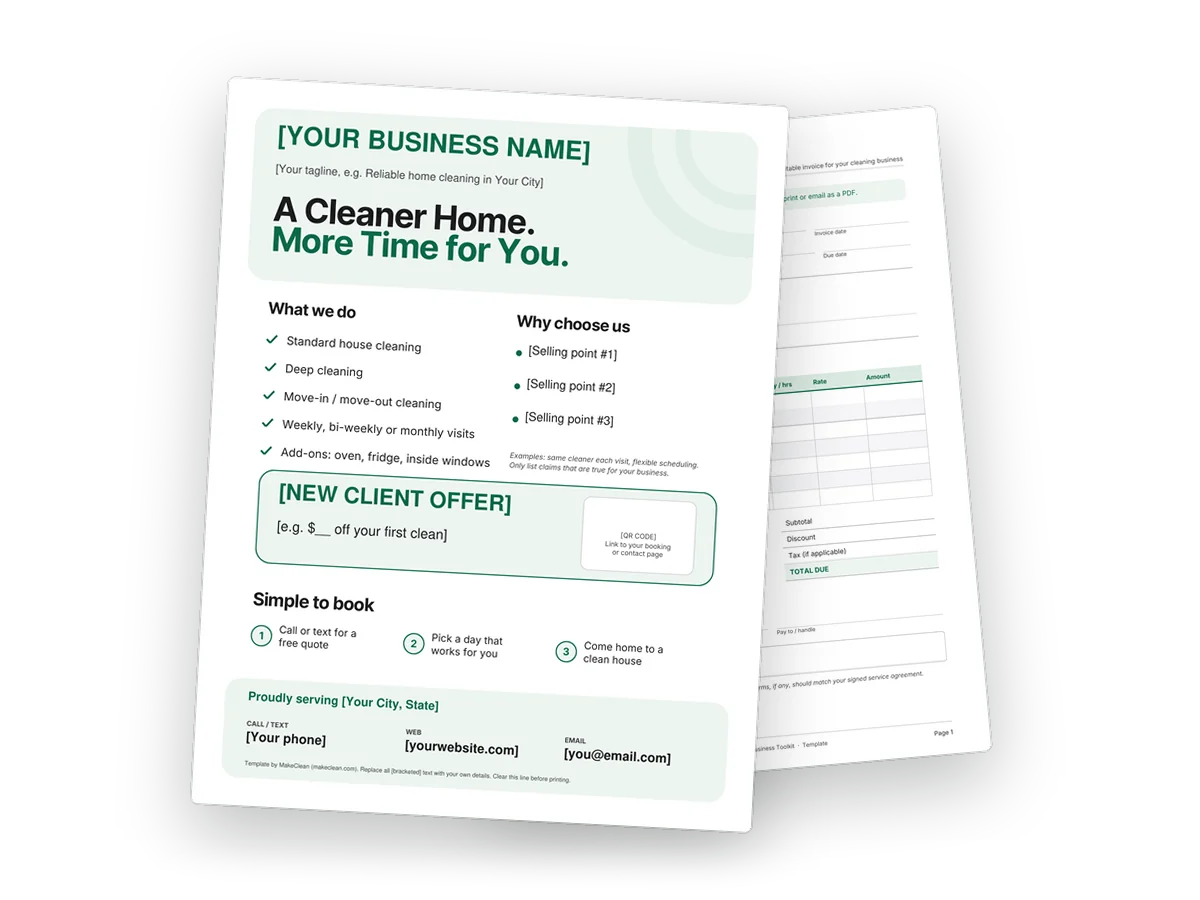
Skip the blank page: the Cleaning Business Toolkit
Nine ready-to-use templates for a new or growing cleaning business, as fillable PDFs and editable Word files:
- Get paid: invoice, estimate/quote, pricing sheet with a private rate worksheet
- Win clients: flyer, door hanger, new-client intake form
- Do the job right: residential and move-out checklists, client agreement template
Instant download, one-time purchase. Put your business name on them tonight and use them on your next quote.
instant download
Launch offer: use code LAUNCH30 at checkout for 30% off the toolkit, until November 30, 2026.
Buy the toolkit — $12 See what is inside
Secure checkout by Payhip (card or PayPal)
The agreement is a template, not legal advice. Have it reviewed for your state.
Free: pricing cheat sheet, estimate template and checklist for cleaners
Get the 2-page cleaning pricing cheat sheet (formula, worked example, per-square-foot ranges and what to ask before you quote), the service estimate / quote template and the residential cleaning checklist (fillable PDFs), plus occasional cleaning-business tips.