Home / Guides / Cleaning business
Cleaning business
How to start a house cleaning business: a step-by-step guide
Starting a house cleaning business is cheap compared with most small businesses, but the boring steps (legal setup, insurance, pricing, paperwork) are what separate a hobby from a business clients trust. Here is the order that makes sense, with sourced cost ranges and the traps to avoid.
Cost figures are third-party estimates that differ widely. Costs and rules depend on your state, city and whether you hire. Checked November 16, 2026.
1. Decide what you are selling
- Who: residential (homeowners, renters), short-stay hosts, small offices, or move-in and move-out jobs. Pick one or two to start. A narrow focus makes your pricing, checklists and marketing simpler.
- How: solo, with a partner, or with employees. Solo is the fastest start. Hiring brings payroll, workers' compensation and training.
- Where: a service radius that keeps drive time reasonable. Drive time is unpaid time unless you price it in.
2. Set up the business legally
- Structure. Many small cleaning businesses form an LLC to separate personal and business liability. the US Small Business Administration explains the main structures. Filing fees vary by state.
- EIN. An Employer Identification Number is free from the IRS. You need it to open a business bank account if you are not a sole proprietor, and to hire. Beware sites that charge for it.
- Local license. Many cities and counties require a general business license. Check your city and county websites.
- Separate bank account. Keep business income and expenses apart from the start so tax time is easier.
3. Insurance
Most customers will not hire an uninsured cleaner, and you do not want to pay for a broken heirloom out of pocket. FieldCamp estimates general liability insurance for a small cleaning company at about $500 to $1,500 a year, workers' compensation at about $900 to $2,400 a year once you have employees, and a janitorial bond at about $100 to $300 a year. Fit Small Business gives wider ranges. Get quotes from a couple of agents or online brokers and ask exactly what is covered, including client keys and damage to property.
4. Startup costs: what to expect
FieldCamp puts a low-end first-year budget around $1,200 and an average around $5,500, with big swings if you buy a vehicle. Fit Small Business estimates $1,000 to $5,000 total. A solo cleaner with a personal car can start toward the low end: supplies and equipment, insurance, a license, and a little marketing.
Rule of thumb (ours)Buy a small, good kit first. Add equipment when real jobs show you what you actually use.
5. Price for profit
Work from your costs, then check local competitors. Our guide how much to charge for house cleaning explains the formula, and the price calculator does the math.
6. Get your paperwork professional
Clients judge you by what they can see before you arrive: a clear estimate, a task checklist, an agreement that says what is and is not included, and an invoice with payment options. The Cleaning Business Toolkit ($12) bundles an invoice, estimate/quote, new-client intake form, residential and move-out checklists, flyer, door hanger, pricing sheet and a client agreement template as fillable PDFs and editable Word files. The agreement is a template, so have it reviewed for your state.
7. Pick a name and make it findable
Use something easy to spell, easy to say on the phone, and available as a domain and social handle. See cleaning business name ideas and try the name generator.
8. Find your first clients
Start with free channels: a Google Business Profile, neighbors, local community groups, and partners such as realtors and short-stay hosts. We cover them in how to get your first house cleaning clients.
9. Decide whether you need software yet
Not on day one. A spreadsheet and a calendar handle the first handful of clients. When scheduling, invoicing and reminders eat your evenings, see our software comparison.
Common traps
- Calling workers "contractors" to avoid payroll. Worker classification rules are strict and differ by state. Ask an accountant or your state labor department.
- No written agreement. Misunderstandings about scope, cancellations and damage are the most common source of disputes.
- Pricing from fear. Underpricing to win work leaves no money for insurance, slow weeks or growth.
- Mixing business and personal money. It makes taxes and profit tracking harder.
This is general information for small cleaning businesses, not legal, tax or insurance advice. Rules differ by state and city, so check with your state or city, an accountant or an insurance agent before you rely on any of it.
Questions people ask
How much does it cost to start a house cleaning business?
Estimates range from about $1,000 to $5,000 for a typical small start (Fit Small Business) to a first-year average near $5,500 (FieldCamp). Insurance, supplies and licensing are the main items; a vehicle is the biggest swing.
Do I need insurance to start a cleaning business?
Insurance is not a substitute for checking your state and city rules, but most clients expect it and you are exposed to property-damage claims without it. Many cleaners start with general liability and add workers' compensation when they hire.
Do I need an LLC?
Not necessarily. It is a common choice because it separates personal and business liability, but the right structure depends on your situation. the US Small Business Administration explains the options, and an accountant or attorney can advise you.
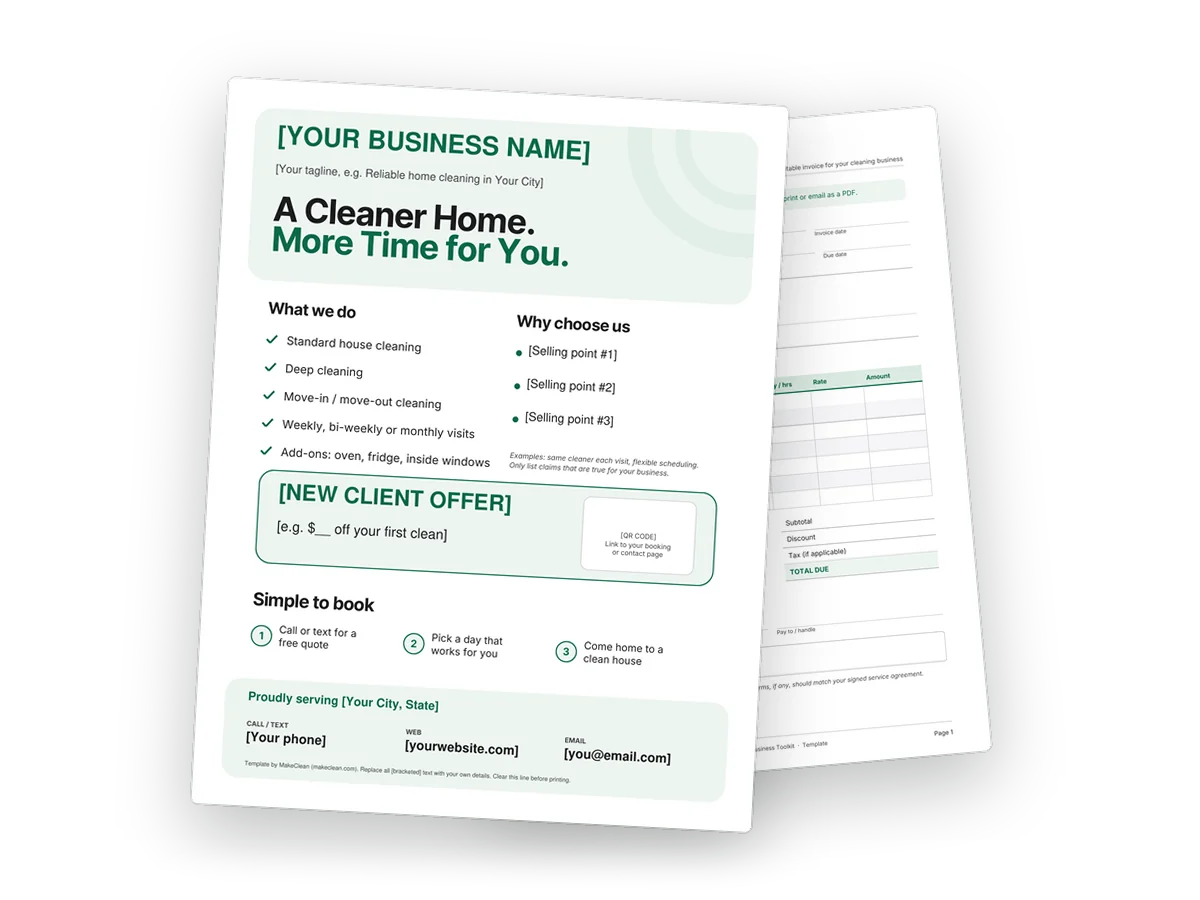
Skip the blank page: the Cleaning Business Toolkit
Nine ready-to-use templates for a new or growing cleaning business, as fillable PDFs and editable Word files:
- Get paid: invoice, estimate/quote, pricing sheet with a private rate worksheet
- Win clients: flyer, door hanger, new-client intake form
- Do the job right: residential and move-out checklists, client agreement template
Instant download, one-time purchase. Put your business name on them tonight and use them on your next quote.
instant download
Launch offer: use code LAUNCH30 at checkout for 30% off the toolkit, until November 30, 2026.
Buy the toolkit — $12 See what is inside
Secure checkout by Payhip (card or PayPal)
The agreement is a template, not legal advice. Have it reviewed for your state.
Free: pricing cheat sheet, estimate template and checklist for cleaners
Get the 2-page cleaning pricing cheat sheet (formula, worked example, per-square-foot ranges and what to ask before you quote), the service estimate / quote template and the residential cleaning checklist (fillable PDFs), plus occasional cleaning-business tips.